

Original writing: Maximilian Mauroner, 20 June 2019.
Retrospective: September 2026.
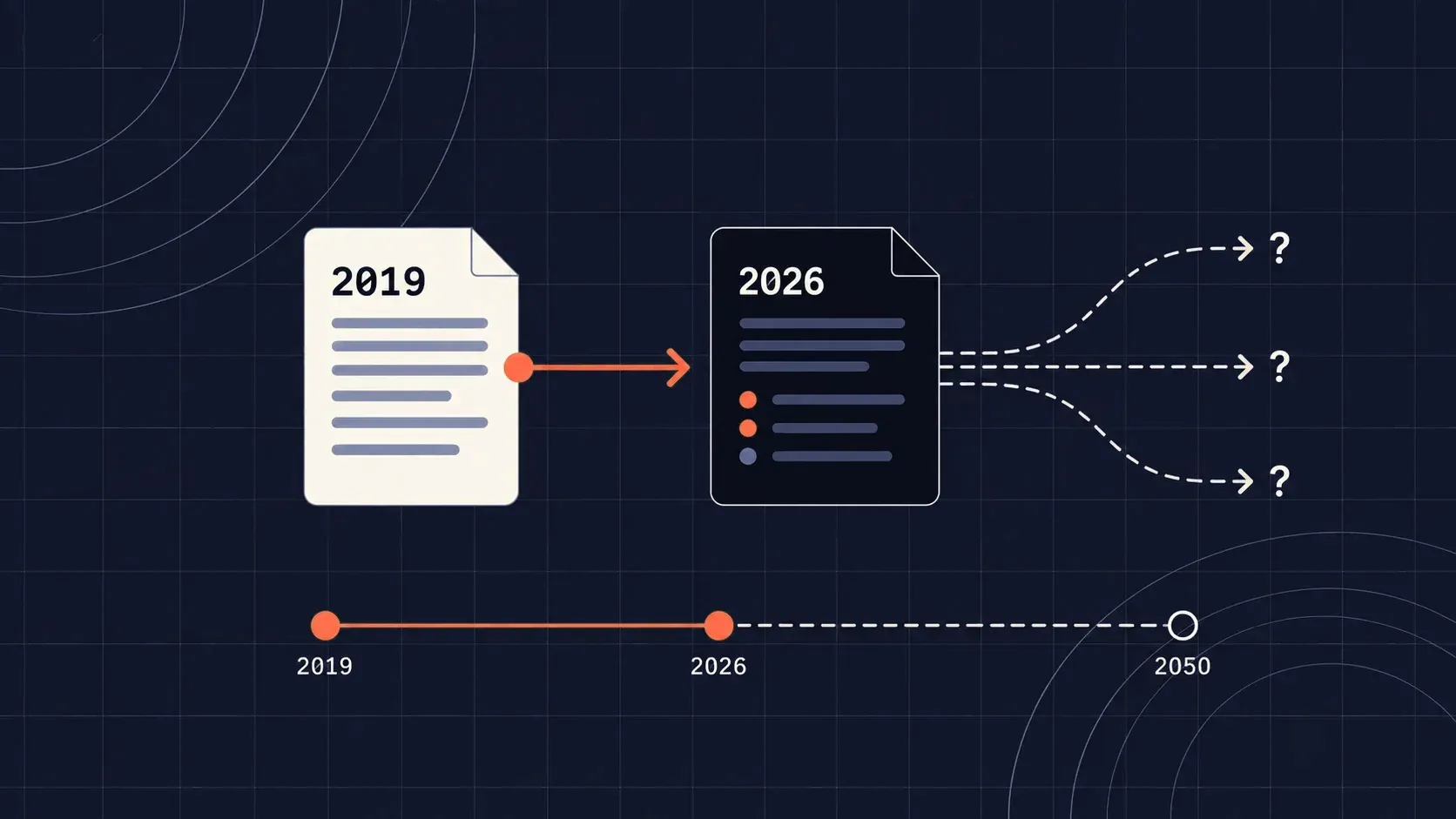
In June 2019, I finished a school paper called Die Zukunft von KI, or The future of AI, at the vocational school in Bolzano. I chose the subject because I was learning to be a programmer and wanted to understand something I thought would become important for my work. I was also fascinated by the idea of a machine learning to do things we usually associate with thinking. Seven years later, I wanted to read it again and see how the future I pictured compares with what actually happened.
I expected AI to show up in our devices, change how we work, and become useful in medicine. A lot of that now feels familiar. Other parts, especially what those changes would mean for people’s lives, are still much less settled.
The quotes below are translated from the German paper. Each is followed by how I see it in 2026. The linked PDF is a 2026 excerpt of the paper: it omits the practical project section and keeps the original page numbers in its footers.
What I thought would happen
Programmers would have no way around AI
2019 · Original, page 3, opening section
I think it is very important as a programmer to know something about this subject, and in the future, there will be no way around AI for programmers.
2026 verdict: Hit.
AI has become a normal part of the conversation about programming. In Stack Overflow’s 2025 survey, 84% of respondents said they used or planned to use AI tools in their development process.
That is close to what I had in mind. I thought understanding AI would matter for the work I wanted to do. It does not mean every programmer needs an assistant for every task, but the subject is much harder to ignore now.
AI in every electronic device within ten years
2019 · Original, page 9, “Die Zukunft von KI”
I suspect that within ten years at most, we will have an AI in every electronic device to make our lives easier.
2026 verdict: Partial hit.
Apple began shipping Apple Intelligence in October 2024 on supported iPhones, iPads, and Macs. AI becoming part of the devices people already own is very much the direction I imagined.
We are not at every electronic device, and the ten years I gave it run until June 2029. But I find the way it is arriving interesting. It can come through a software update to something familiar, rather than through buying a separate machine that looks like the future.
We would hear much more about AI
2019 · Original, page 9, “Die Zukunft von KI”
In the near future, we will hear more and more about AI, since its development only began to be considered worldwide a few years ago.
2026 verdict: Hit.
This part has happened. Pew’s 2025 survey found that 34% of US adults had used ChatGPT, roughly double the share in 2023.
AI was already around when I wrote the paper. I mentioned recommendation systems and digital assistants, and the research itself went back decades. What feels different now is how directly people can interact with it. Asking a model for help is a much more visible experience than having an algorithm decide what appears in your feed.
Pattern recognition would save lives
2019 · Original, page 8, “Die Zukunft von KI”
Because AI is so good at finding patterns, it will save countless people’s lives in medicine.
2026 verdict: Partial hit.
Medicine was one of the reasons I felt optimistic about AI. Finding something in an image that a person might overlook seemed like a very useful thing for a computer to do.
The FDA’s list of AI-enabled medical devices now includes authorized uses across medical specialties, with many imaging applications. That is encouraging, although the list alone cannot tell us how many lives those tools have saved.
I had already read about applications such as identifying diabetic retinopathy in photographs in 2019. So this was partly an expectation that work already underway would become more useful and more widely used. I still think that is a good reason to care about the technology.
Job losses would make basic income necessary
2019 · Original, page 8, “Die Zukunft von KI”
Because AI has so many applications in which it works much more efficiently than a human, many people will probably lose their jobs and gradually be replaced by robots. We would then have to introduce a universal basic income.
2026 verdict: Miss so far.
I imagined a future where machines did more of the work and people had more time for what they actually wanted to do. Basic income was how I pictured that working financially.
The picture since then has been more mixed. The ILO’s 2025 analysis estimated that one in four workers worldwide had an occupation with some exposure to generative AI. It expected transformation of jobs to be more common than redundancy. Exposure is not the same as a job disappearing, but it gives some sense of how many kinds of work could change.
The move from automation to basic income has not followed the straightforward path I imagined. I now see more room between a machine becoming capable of a task and a society deciding what to do with that capability. More time for ourselves is still an appealing outcome. It does not follow automatically from better software.
Human-level AI would quickly become more intelligent than us
2019 · Original, page 6, “Starke KI”
The difference, though, is that an AI learns far faster than a human and therefore becomes more intelligent than a human after only a short time.
2026 verdict: Unresolved.
I thought reaching human-level intelligence would be the point after which things moved very quickly. Once a machine could learn and think as well as us, I expected it to keep going.
This is still open. The International AI Safety Report 2026 describes systems that excel at difficult tasks but still fail at simpler ones. That makes the current situation less tidy than the progression I had in mind. Being very good at coding or mathematics does not mean being equally capable at everything else.
I can still see why the possibility interested me in 2019. I am less sure that there will be one obvious moment when we can say we have crossed that line.
Living in harmony with intelligent robots by 2050
2019 · Original, page 14, “Fazit”
I am confident that by 2050 we will live on a planet where we live in harmony with intelligent robots.
2026 verdict: Unresolved.
This was the most optimistic part of the paper. I pictured intelligent robots as something we would eventually share our world with, and I expected that to turn out well.
There are small steps in that direction. BMW’s account of its humanoid robot work describes a 2025 pilot at Spartanburg and subsequent work in Leipzig. Factory work is a much narrower setting than the future I pictured, but it is interesting to see the idea move into practical use.
2050 is still a long way off. I would leave this one open. The hopeful part of it still appeals to me, even if useful robots and living well alongside them are two things we will have to work out together.
How my view has changed
I was optimistic about what AI could do, and I connected technical progress quite directly to a better life. If machines could do more, we would have more time. If they could recognize patterns, medicine would improve. If robots became intelligent, we would find a way to live alongside them.
I still find those possibilities appealing. But I think more about what happens between a useful capability and the outcome people want from it. How a tool is used, who gets access to it, and what changes around it matter too. The jobs and basic-income section is where that difference stands out most to me now.
The safety section reads differently to me as well. I was hopeful about the benefits while also writing as if humans would have no say once full AI existed. Today I would put more weight on the choices we make along the way. The 2026 safety report describes uncertainty and disagreement about loss of control. There is a lot to work on before treating any one outcome as inevitable.
Reading the OpenAI section again
The OpenAI section is probably the part I most enjoyed finding again. On pages 9 and 10, I wrote about OpenAI Five and its win against OG. OpenAI reported that victory in April 2019, a couple of months before I finished the paper.
I also wrote this on page 10:
OpenAI trained an AI to predict the next word in a text. They used 40 gigabytes of text from the internet, with the end result that the AI could produce realistic texts and sentences.
I went on to describe coherent writing and the decision to release a smaller version because of misuse concerns. This matches OpenAI’s February 2019 GPT-2 announcement. GPT-2 was already public news. I did not name it in the paper.
I did not predict ChatGPT. I was describing something that already existed. But reading about next-word prediction, coherent text, and concerns about misuse in my own school paper brings me back to what caught my attention then. Language generation already seemed worth paying attention to, even though I had no clear picture of what using it would look like a few years later.
Looking ahead again
What stands out to me now is how familiar some of these ideas have become. In 2019, I was reading about machines generating coherent text and wondering where that could lead. Now I am looking back at that paper in a world where people use those systems to write, learn, and build things.
I still recognize the optimism in it. I want AI to help us do useful work and give us more time for the things we care about. I am less convinced that those benefits will follow on their own, but the possibility is still what makes the subject interesting to me.
There are another three years until the device prediction reaches its deadline, and quite a few more until 2050. I would like to come back to this again. For now, I am glad I wrote down what I thought before I knew how any of it would turn out.